How to Choose the Right Journal or Sketchbook

I’ve tried countless times to be someone who kept a sketchbook or a journaling system. I’d start strong, hit a wall, and stop. Over the last few years, I decided the practice actually mattered to me, so I stepped back and figured out what worked and what didn’t.
It can feel daunting, so here’s a simple way to start a journaling practice that actually resonates, based on a lot of trial and error.
Purpose
Before you buy anything, ask what the journal is for. I used to think I could keep ideas and drawings all in one place. That never worked for me. Journaling is about exploring, letting go of ideas, and giving them somewhere to live so you can return to them later. For me, compartmentalizing made everything easier.
Ask yourself what you’ll use it for. Daily notes, morning pages, commonplace entries, junk journaling, planning, sketching in pencil or pen, or painting. The clearer the purpose, the easier every other choice becomes.
Journal Size
Once you know the purpose, size gets easier. Think about your lifestyle. If it’s too bulky, you’ll leave it behind. If it’s too small, you may feel cramped. Choose something that fits into your routine.
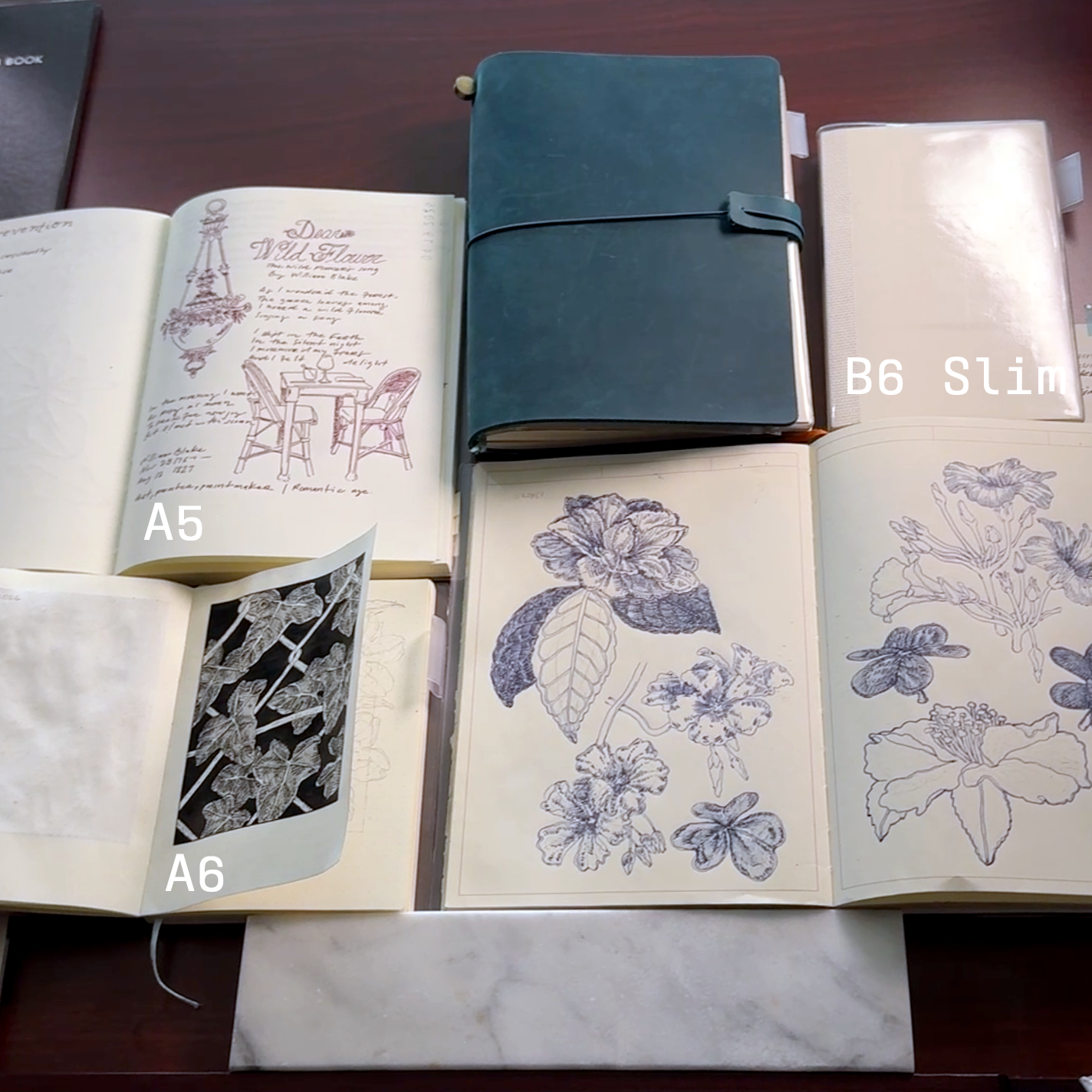
For writing-heavy practices like morning pages or commonplace journaling, I’ve found A5 is a great place to start. It’s not too big or too small, and it holds a collection of thoughts in a way that feels substantial. It also works well for sketching since it gives you enough space to explore freely. It’s my size of choice to live on my desk but can also travel with me without feeling cumbersome.
If you want something that moves between your desk and your bag, a proper on the go journal, A6, passport or something from Travelers Factory will be a great choice.
If you want something that lives on your desk as a catch-all, go larger like an A4. This one is large and in charge!
After you select your size, think about paper count. If you want something on going, look at page counts in the 100s. If you want something thinner to compartmentalize, think of slim notebooks 48 pages. With thinner notebooks you can explore ideas in individual notebooks instead of fusing thoughts into one place.
Size Should Match Your Life
| Journal Size | Use |
|---|---|
| Pocket-sized and A6 (small) | Easy to carry, great for daily habits |
| A5 and Travelers Factory Regular (medium) | Balanced for everyday journaling + sketching |
| A4 + (Large) | Ideal for expressive work/ideas, but less portable |
Journal Paper Amount & Color
I’m a tactile person, so paper matters a lot to me. Thickness, color, texture, all of it. Paper is where everything happens, so don’t treat it as an afterthought. The wrong paper can slowly push you away from using your journal.
So when picking your paper, start with color. Do you want something bright white or warm and soft? It sounds small, but it changes how the page feels. I like to think of the feeling of the paper and often choose off white or cream color paper, even for my sketchbooks!
After that, think of paper quality. Paper comes in many weights and coatings.
| Paper Weight | Use |
|---|---|
| Thin paper (70–100 gsm) | Good for writing, not great for heavy ink or paint |
| Mid-weight (100–160 gsm) | A solid middle ground for pens and light washes |
| Heavy paper (160+ gsm) | Better for paint, markers, and mixed media |
There are exceptions. Some thinner papers handle ink beautifully, like Tomoe or Midori-style papers designed for fountain pens.
Texture matters too:
Smooth paper works well for pens and clean linework
Textured paper is better for pencil or more expressive work
Binding Changes The Experience
When I went to art school, I took a bookbinding class, and it completely changed how I think about journals. Binding is what determines how a book opens and how it meets you on the page.
Lay-flat or sewn: easier for drawing & journaling across pages
Spiral orring: flexible and low pressure
Hardbound or glued: durable, more structured
If you don’t like how it opens, you won’t use it. I personally always reach for journals that lay completely flat.
Aesthetics Matter
I’m very driven by how things look and feel, and I don’t think that’s a bad thing.
A journal shouldn’t just feel usable, it should call you back. Sometimes it’s the cover, the texture, or even the color that draws you in and makes you reach for it again.
At the beginning, a journal can be simple, like everyone else’s, but over time I want it to feel like mine, something I could spot from a mile away.
I like using leather covers and switching them out depending on my mood. It’s a small shift, but it keeps the practice feeling fresh and personal.
Over time, the real beauty comes from use. Let your journal wrinkle, bleed, and soften at the edges. Let it collect scraps, marks, and moments that reflect you. It should feel lived-in, like a snapshot of who you are in that moment.
A good journal isn’t one you protect. It’s one you return to.
Where Will You Put Your Thoughts?
Instead of asking, “What’s the best journal?” try asking: “What kind of space do I want to create for myself?” Answering that makes the choice a lot clearer.
I hope these five insights help you find a journal and size that actually fits your life. Journaling is something I’ve failed at more times than I can count, but now it’s become a place where I find peace of mind and get to explore my thoughts freely. It’s a space to simply be myself, without the weight of anxiety, fear, or pressure.
Happy journaling.
x Izza